Person Record
Images
Metadata
Name |
Clark, Roy Linwood |
Role |
Banjoist |
Spouse |
Barbara |
Places of residence |
Virginia/Oklahoma |
Sphere Of Activity |
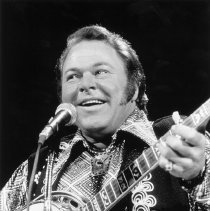
Taking the best from an impoverished childhood and developing an innate talent into international superstardom, the life and career of the man known as America's Super Picker, Roy Clark, can only be described as extraordinary. Born with music in his heart in1933 in Meherrin, Virginia, Roy Linwood Clark, is the son of two amateur musicians. Roy's interest in music surfaced at the age of 11 when he began playing around with his father's tenor banjo. Practicing his instruments so much that his fingers bled, Roy won two national banjo championships and, at the expense of his school work, was simultaneously pursuing both his music as well as a career in baseball and boxing. After appearing on local radio and television, however, when an invitation to do a guest performance on the Grand Old Opry came at the age of 17, Roy Clark dedicated himself solely to his music. After spending a year in Nashville working with Grand Ole Opry stars such as Grandpa Jones, Ernest Tubb and Red Foley, in 1951 Roy Clark returned to the Washington, D.C. area where he could play not only country, but pop, jazz and rock n roll as well. Roy joined Jimmy Dean's band in 1954, appearing as a regular on Dean's Town and Country Time television program. After his habitual tardiness caused Dean to fire him, at the age of 27 and out of work, it Wanda Jackson's offer for him to come to Las Vegas that turned out to be the turning point in Clark's career. Fighting a chronic lack of self-confidence, the following years saw Roy work diligently as he developed his unique, stand-alone talent as a multi-instrumentalist, singer and comic. His path to stardom nearly complete, in 1962 Roy signed with Capitol Records and released his first solo instrumental album, The Lightning Fingers of Roy Clark. The early 1960s were pivotal in the career of Roy Clark. After appearing on the Tonight Show and seeing his instrumental recordings enjoying significant airplay, Capitol executives quickly capitalized on Roy's ability as a vocalist, releasing his first hit vocal recording, The Tips of My Fingers in 1962. Clark's rural sense of humor was equally effective when he played dual roles on numerous episodes of the Beverly Hillbillies. With unquestionable momentum, by the late 1960s Roy Clark's career was on the verge of a full-blown explosion. In September of 1968, CBS producers approached Roy with an idea for a show that was a country version of NBC's hit Laugh In. Saying 'yes' to the concept, Clark was stunned when his manager, Jim Halsey, called him and said, 'They're getting ready to do that show.' Clark replied, 'What show?' The show he'd forgotten he agreed to do - Hee Haw - went on the air in June of 1969. Universally panned by critics, Hee Haw was an instant sensation among the public, making Roy Clark the face of the banjo for a generation. Despite its high ratings, CBS cancelled Hee Haw in 1971. Moving into syndication without missing an beat, Hee Haw went on for another 20 years making it the longest running weekly syndicated series in history. With Hee Haw firmly establishing him as an American entertainment icon, in the 1970s and 80s Roy Clark came to symbolize country music to a new generation. He toured constantly, often selling out the showrooms of major venues in Las Vegas while upholding his country roots as a member of the Grand Ole Opry. In addition to Hee Haw, Roy was a regular on numerous talk, sitcom and variety television shows, including becoming a regular guest host for Johnny Carson on the Tonight Show. An unlikely international emissary of peace and goodwill, in 1976 Roy Clark became just that as the first country music artist to perform in the Soviet Union. After hosting a delegation of Soviets in Las Vegas, Clark was invited to tour of their country, ultimately playing 18 concerts to sold out audiences. Following the tour, the State Department praised Clark for opening diplomatic doors which had been closed for decades. When he returned to Russia in 1988 by invitation of Premier Gorbachev, Roy Clark was hailed as a hero. Although he's a member of the Country Music Hall of Fame and the recipient of every award and honor his industry can bestow, Roy Clark's decade-defying success can be summed up in one word - sincerity…a sincere smile, a sincere wit, and a sincere love of music as well as his audience. But there is more…his performances touch listeners with a personal connection that comes from within and extends far beyond music and laughter. Simply put, Roy Clark is a unique and truly once-in-a-world performer. Johnny Baier, American Banjo Museum |
Related Records
-
-
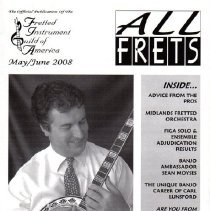
Fretted Instrument Guild of America ALL FRETS May/June 2008 Sean Moyses - Periodical
2008.008-0007
Record Type: Archive
-
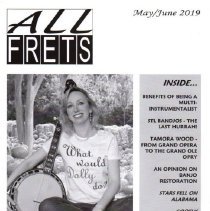
Fretted Instrument Guild of America ALL FRETS May/June 2019 Tamora Wood - Periodical
2019.012-0017
Record Type: Archive
-
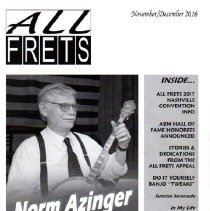
Fretted Instrument Guild of America ALL FRETS November/December 2016 Norm Azinger - Periodical
2017.002-0003
Record Type: Archive
-
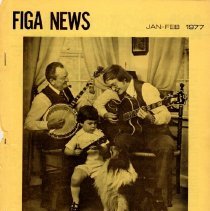
Fretted Instrument Guild of America FIGA News January/February 1977 Mel Bay and Family - Periodical
2004.011-0037
Record Type: Archive
-
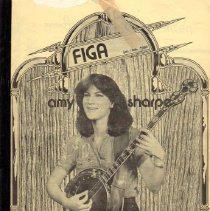
Fretted Instrument Guild of America January/February 1980 Amy Sharpe - Periodical
2004.011-0055
Record Type: Archive
-
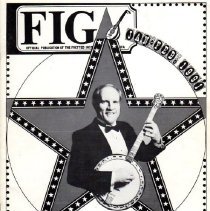
Fretted Instrument Guild of America January/February 1991 Buddy Griffin - Periodical
2010.001-0027
Record Type: Archive
-
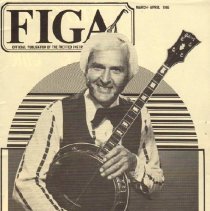
Fretted Instrument Guild of America March/April 1986 Borgy Borgerson - Periodical
2004.011-0012
Record Type: Archive
-
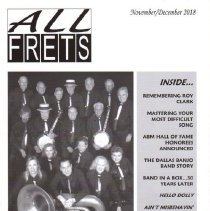
Magazine: Fretted Instrument Guild of America ALL FRETS November/December 2018 Dallas Banjo Band - Periodical
2018.023-0012
Record Type: Archive
-
Magazine: Fretted Instrument Guild of America November/December 2014 St. Louis Bandjos - Periodical
2014.004-0025
Record Type: Archive