Person Record
Images
Metadata
Name |
Sweeney, Joel Walker |
Role |
Banjoist |
Places of residence |
Virginia |
Sphere Of Activity |
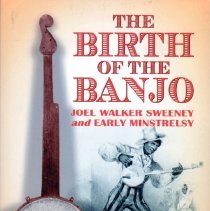
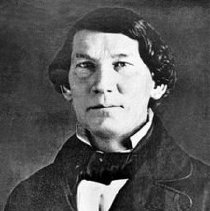
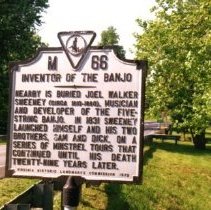
To understand his importance, one must think of Joel Walker Sweeney as a rock star of the 1840s. He virtually created the term "professional banjo player" and introduced mainstream America to a music - and a musical instrument - which, until him, was almost exclusive to the transplanted black culture of the southern slave. The Irish American Sweeney sampled African American music, added other southern sounds, and essentially created a new musical genre. And, as one of the first and certainly most popular of the traveling minstrels, Sweeney brought his music - and the banjo - to the public. Hearsay abounds in the telling of Sweeney's story. He is often given credit for originating the fifth-string on the banjo or inventing the instrument itself. Some speak of Sweeney as being the first white man to actually play the banjo. While none of these statements are accurate, Sweeney did introduce an improved African-American banjo into popular culture and inspired, taught or performed alongside the most important first generation banjoists in early minstrelsy. In these roles, the extent of Joel Sweeney's influence cannot be understated. Joel Walker Sweeney was born in 1810 in what is now Appomattox, Virginia. Already known as a violin player, somewhere around his 13th year Sweeney heard nearby African slaves playing the banjo and, after learning to play from them, adopted the instrument as his own. Although certainly not the first Anglo-American banjoist, when Sweeney was performing locally by the mid-1830s, the banjo was still little more than a curiosity among white Americans. Coming of musical age along with the long abandoned practice of white entertainers performing in blackface known as minstrelsy, Sweeney, followed the lead of established minstrel stars but was the first to add the new element of the banjo to his minstrel offerings. Graduating from local dances, taverns and public events, Sweeney's star grew as he progressed rapidly through the ranks of east coast theatrical and circus performers, ultimately being hailed in 1841 by the New York Post as "The only banjo player in existence." As the minstrel star who brought the banjo to acceptance on legitimate theatrical stages in New York, Boston and Baltimore, the success of the artist now billed as "Joe Sweeny" spawned numerous imitators. With former students becoming his competition, in 1842 Sweeney slyly ventured into virgin territory, introducing his unique presentation of the American banjo to overseas audiences during a highly successful three-year tour in Great Britain. Whether he was homesick or had simply "played out" British venues, when Sweeney returned to the U.S. in 1845 the minstrel scene had changed, now being populated with new stars as well as the countless minstrel troupes which had established themselves as preeminent during his absence. He returned to Appomattox where, while the excitement surrounding one of his infrequent solo performances had not diminished, Sweeney, following the industry trend, founded his own minstrel troupe along with brothers Sam and Richard. Although he remained sporadically active; performing alone, with his brothers, or with other established minstrel troupes, Sweeney never reclaimed the popularity he enjoyed in the U.S. prior to his overseas tour. With the passing of his brother, Dick, and mother, Tabitha, in 1860 Sweeney withdrew from performing, aware that his fame was receding and his music falling from favor. Contracting an unknown illness, his health failed rapidly and on October 29th, 1860, Joel Walker Sweeney died at the age of 50. Sweeney's rise to minstrel stardom in not unlike the story of Elvis Presley's rise to rock 'n roll fame…both were Southern white musicians who, while serving as a bridge between black and white cultures and music, became wildly famous. It was, however, the inventive banjo milestones which he set - the influence of which are still felt today - which make Joel Walker Sweeney arguably the most important individual figure in early banjo history. Johnny Baier, ABM Executive Director |
Mother |
Tabitha |
Father |
Dick |
Related Records
-
Fretted Instrument Guild of America ALL FRETS January/February 2007 Mike Currao - Periodical
2007.010-0006
Record Type: Archive
-
Fretted Instrument Guild of America ALL FRETS January/February 2010 Jim Riley - Periodical
2010.014-0003
Record Type: Archive
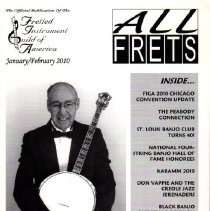
-
Fretted Instrument Guild of America ALL FRETS March/April 2010 Bill Pincumbe - Periodical
2010.014-0005
Record Type: Archive
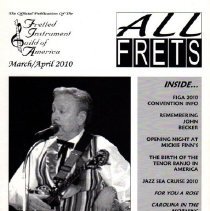
-
Fretted Instrument Guild of America ALL FRETS May/June 2018 Robert VanRenesse - Periodical
2018.014-0015
Record Type: Archive

-
Fretted Instrument Guild of America ALL FRETS November/December 2013 Wayne Fairchild - Periodical
2013.033-0003
Record Type: Archive
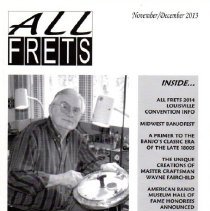
-
Fretted Instrument Guild of America ALL FRETS November/December 2016 Norm Azinger - Periodical
2017.002-0003
Record Type: Archive
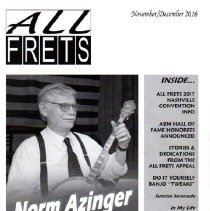
-
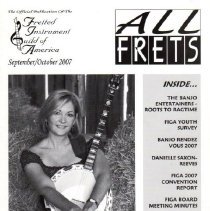
Fretted Instrument Guild of America ALL FRETS September/October 2007 Linda Lehmann - Periodical
2007.010-0010
Record Type: Archive
-
Fretted Instrument Guild of America FIGA News January/February 2003 Dr. Joan Dickerson - Periodical
2003.037-0008
Record Type: Archive

-
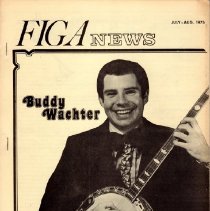
Fretted Instrument Guild of America FIGA News July/August 1975 Buddy Wachter - Periodical
2018.024-0062
Record Type: Archive
-
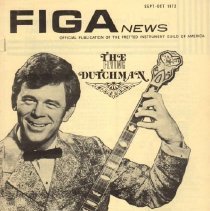
Fretted Instrument Guild of America FIGA News September/October 1972 Don Van Palta - Periodical
2010.001-0037
Record Type: Archive
-
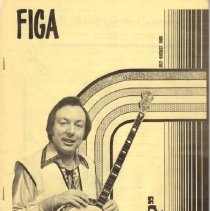
Fretted Instrument Guild of America July/August 1980 Howard "Shep" Shepherd - Periodical
2004.011-0057
Record Type: Archive
-
Fretted Instrument Guild of America March/April 1980 Judy and Pat Terry, Jr. - Periodical
2004.011-0056
Record Type: Archive
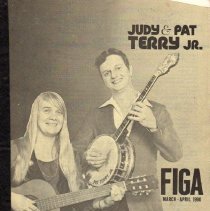
-
Fretted Instrument Guild of America March/April 1982 Mike Fultz - Periodical
2004.011-0067
Record Type: Archive
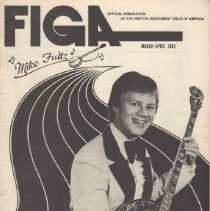
-
Fretted Instrument Guild of America May/June 1979 Timothy J. Allan - Periodical
2004.011-0049
Record Type: Archive
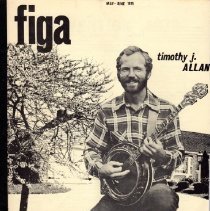
-
Fretted Instrument Guild of America May/June 1982 Stephen DiBonaventura - Periodical
2004.011-0068
Record Type: Archive
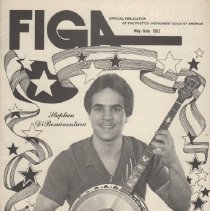
-
Fretted Instrument Guild of America September/October 1992 Patty Fischer - Periodical
2004.094-0008
Record Type: Archive
-
-
Magazine: International Banjo Magazine March/April 1981 Carl Jackson - Periodical
2000.001-0004
Record Type: Archive
-